
Erasmus + Project “S.O.S. – 4” Survay results
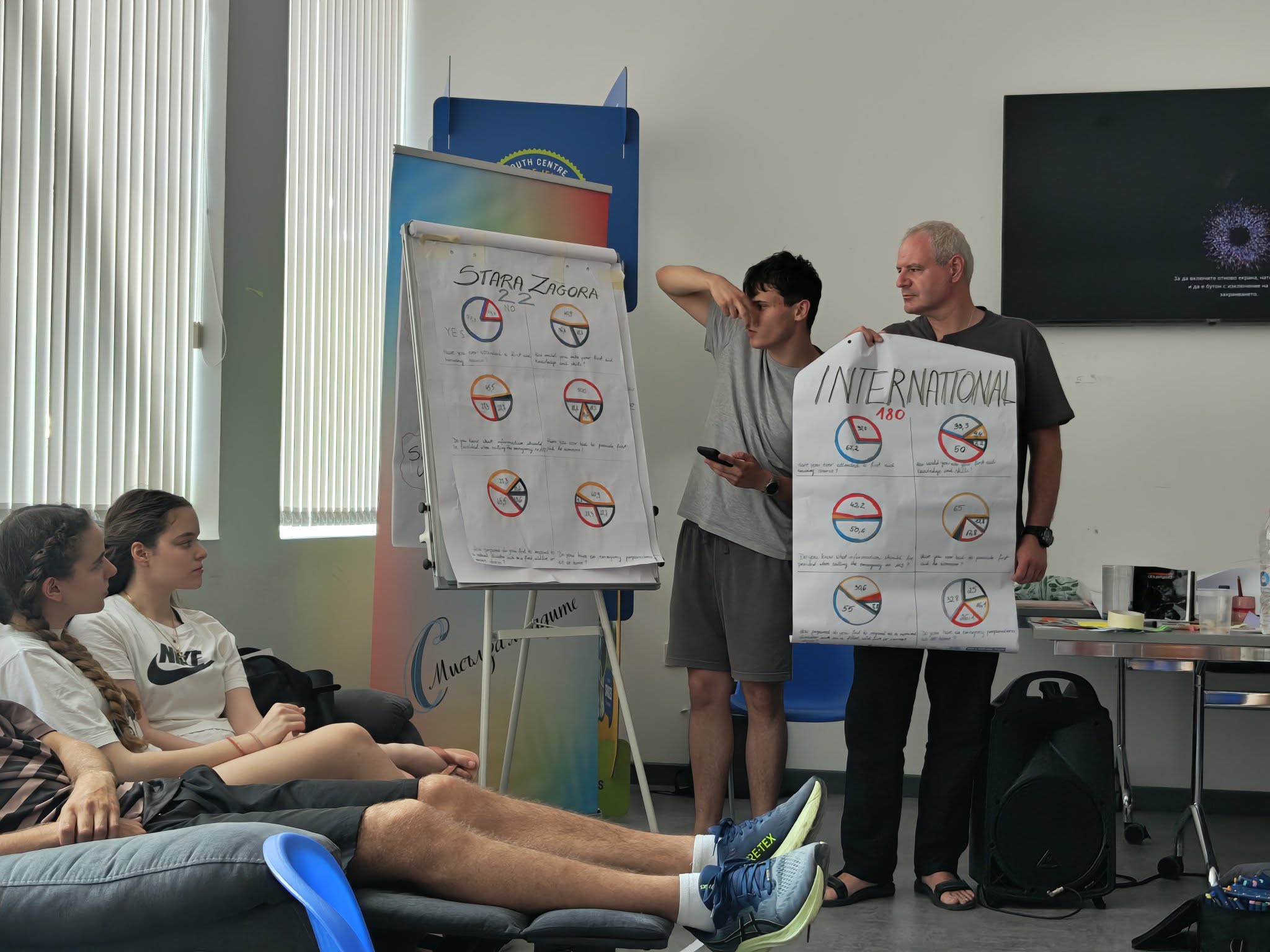
We asked the participants in the project “S.O.S. – 4” to create a survey about first aid. You can see the results and their analysis below. Participants were asked to conduct two surveys: one online, which they were expected to share, and another through direct contact with people. This face-to-face approach was especially relevant to the youth exchange component of the project; however, participants found it difficult to reach many local residents due to the language barrier. Here are the results submitted by the participants:
When Every Second Counts – Findings from the Erasmus+ SOS.4 Project Research
During the Erasmus+ “SOS.4” project, participants were divided into international working groups. Our team consisted of three participants from Poland, one participant from Hungary, and one participant from Portugal. Although we came from different countries and backgrounds, we quickly discovered that our diversity was our greatest strength.
Each team member contributed different skills, experiences, and ideas. Some of us were stronger in communication, others in organization, data analysis, or presentation design. By combining our natural abilities, we created an effective team that supported one another throughout the entire project.
One of our tasks was to develop and conduct research on people’s knowledge of first aid and emergency preparedness. Together, we designed two surveys: one aimed at residents of Stara Zagora, and another distributed internationally through online channels.
At first, we were particularly concerned about the international survey. Our goal was to collect responses from at least one hundred participants, and we had very limited time. To achieve this, we shared the questionnaire with our families, friends, and personal networks, asking them to pass it on to others. Thanks to this collective effort, the survey reached people from multiple countries and ultimately gathered 180 responses, exceeding our expectations.
Conducting the local survey in Stara Zagora was a completely different experience. We approached people in public places and invited them to participate. Although many of those we met were young, language barriers sometimes made communication difficult. Not everyone felt comfortable speaking English. Despite this challenge, local residents were exceptionally friendly, open, and willing to help. Their positive attitude demonstrated that the topic of safety and first aid is important and relevant to the community.
Once the surveys were completed, we faced another challenge: analysing the results within a very limited timeframe. The lack of time pushed us to think creatively, work efficiently, and focus on extracting meaningful conclusions rather than simply presenting charts and percentages.
The findings of both surveys were highly interesting.
On the positive side, many respondents demonstrated basic awareness of first aid and emergency procedures. A significant number had attended first aid training, knew the European emergency number 112, and understood the importance of responding quickly during emergencies.
At the same time, one key conclusion emerged. There is a clear gap between knowledge and action. Many respondents admitted that although they know what should be done in theory, they do not feel confident enough to act independently in a real emergency. This suggests that theoretical knowledge alone is not sufficient. Regular practice, realistic exercises, and hands-on training are equally important.
The surveys also revealed that preparedness for natural disasters and emergency situations remains limited. Many participants did not feel ready to respond effectively during floods, fires, severe storms, or evacuation situations. A considerable number had not discussed emergency plans with their families, established meeting points, or prepared emergency kits.
One particularly important finding was that, regardless of age or nationality, most respondents shared the same concern: the safety of their loved ones. During emergencies, people think first about protecting their families. This demonstrates that preparedness should not be viewed solely as an individual responsibility but as something that involves entire families and communities.
The research also highlighted the importance of communication during emergencies. While most respondents knew the emergency number, far fewer felt confident about communicating effectively with emergency operators or remaining calm under pressure. This indicates that emergency education should include practical communication skills in addition to theoretical knowledge.
The international survey provided another valuable insight. Despite differences in culture, age, and nationality, participants shared remarkably similar concerns. People everywhere want to know how to help others, protect their families, and respond appropriately when unexpected situations occur. Safety is a universal value that transcends borders.
Perhaps the most important lesson from both surveys is that preparedness does not happen automatically. It must be developed through continuous learning, practice, and experience. Knowledge acquired during a single training session is not enough to last a lifetime. Skills must be refreshed and strengthened regularly.
The Erasmus+ “SOS.4” project was much more than a research activity. It provided an opportunity for international cooperation, exchange of experiences, and a deeper understanding of the challenges faced by modern communities. Most importantly, it reminded us that any one of us may one day become the first person able to help in a critical situation.
Safety does not begin when a crisis occurs. It begins much earlier — when we choose to learn, prepare, and take responsibility for ourselves and for those around us. That is when we become ready to help when every second counts.
First Aid Awareness and Emergency Preparedness
Survey Results Analysis
Introduction
First aid knowledge is an important skill that can help people respond effectively during emergencies and potentially save lives. This survey was conducted to understand how prepared people are to act in emergency situations and to evaluate their experience, confidence, and knowledge regarding first aid and emergency response. The questionnaire collected 100 responses from residents of Stara Zagora, Bulgaria, as well as from people from other countries through an online survey.
Results and Analysis
The participants had different backgrounds in terms of nationality, age, and gender. Regarding gender, the majority of respondents were female (60%), while 39% were male and 1% identified as non-binary. Most participants were young adults, with the largest age group being between 18 and 25 years old (55%).
When asked about previous experiences with natural disasters, storms were the most common event experienced by participants, with 45% reporting having experienced them. Earthquakes were reported by 28% of respondents, fires by 20%, and floods by 18%. Around 32% stated that they had never experienced a natural disaster.
The results show that most participants had some level of first aid awareness. Around 64% reported that they had learned about first aid before, while 36% had never received first aid education. Additionally, 69% of respondents believed they had enough knowledge to help someone who became sick, while 31% did not feel prepared to provide help.
Experience with helping injured people was also evaluated. A significant majority (72%) had already helped someone who was injured, showing that many people have faced situations where first aid skills could be useful. However, only a small percentage of participants had experienced a terrorist attack, with 97% answering that they had not.
When participants rated their own first aid skills from 1 to 10, the most common ratings were 6 and 7, both chosen by 17% of respondents. This suggests that many people feel moderately confident but may still lack advanced knowledge or practical training.
Regarding the question of whether participants had ever needed first aid for themselves, the results were relatively balanced, with 54% of respondents answering “no” and 46%
answering “yes”. This shows that almost half of the participants had already been in a situation where first aid could have been necessary.
False alarms also appear to be a relatively common experience, as 67% of respondents reported having experienced one. This highlights that emergency situations, or situations perceived as emergencies, are present in many people’s daily lives.
When asked about providing psychological support to someone in shock, 52% of participants stated that they had already needed to support someone in this situation. However, 77% of respondents reported that they had never personally experienced being in shock, showing that people are more frequently in the position of helping others rather than receiving support themselves.
A very positive result was that 94% of participants showed interest in learning more about how to act in emergency situations. This demonstrates a strong willingness to improve first aid knowledge and suggests that further education and training opportunities could be well received.
Conclusion
The survey results indicate that many people have basic awareness of first aid and believe they can provide help in emergency situations. However, a considerable percentage of participants have never received first aid training, which may affect their ability to react confidently during real emergencies. Increasing access to first aid education and practical training could improve public preparedness and help people respond more effectively when someone needs assistance.
This is the first edition of the article. Keep in mind that it will be changed